
Description
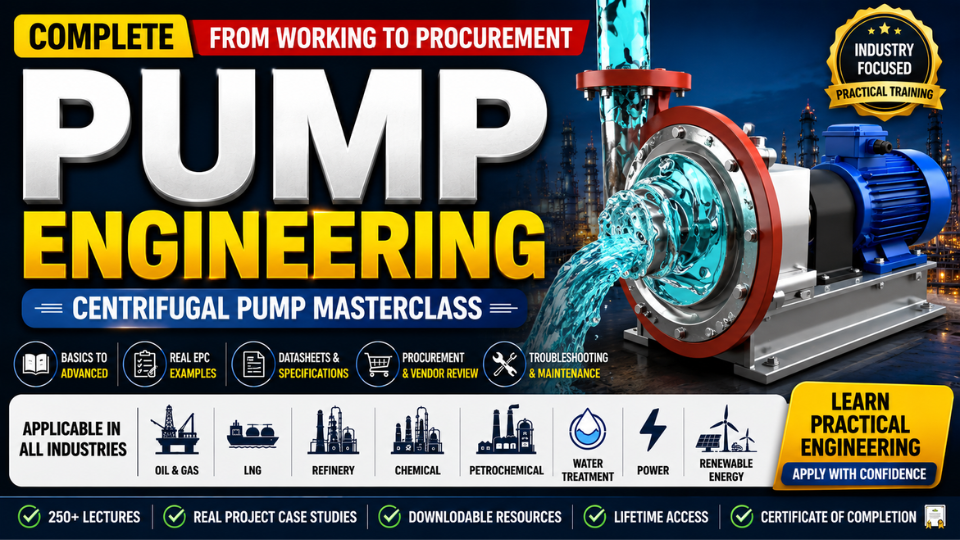
Complete Centrifugal Pump Engineering: From Working Principle to Procurement
Course Introduction
Welcome to the Pump Engineering Masterclass, one of the most comprehensive industry-oriented training programs on Centrifugal Pumps designed specifically for engineers, students, EPC professionals, and plant personnel.
Centrifugal pumps are the heart of every process industry. Whether it is Oil & Gas, LNG, Refineries, Petrochemical, Chemical, Fertilizer, Pharmaceutical, Water Treatment, Power Plants, Hydrogen, or Renewable Energy Projects, pumps play a critical role in transporting fluids safely and efficiently.
However, most engineers know only the basic working principle of a pump. In real industries, engineers are expected to understand pump selection, hydraulic calculations, datasheets, procurement, installation, commissioning, troubleshooting, maintenance, and API standards.
This course has been designed to bridge that gap by providing practical industrial knowledge used by leading EPC companies such as Shell, ExxonMobil, Chevron, Saudi Aramco, ADNOC, TotalEnergies, BP, Technip Energies, Worley, Fluor, Petrofac, L&T Energy Hydrocarbon, etc.
Rather than focusing only on theory, this course follows the complete lifecycle of a centrifugal pump—from understanding how it works to selecting, purchasing, installing, operating, maintaining, and troubleshooting it in real industrial projects.
By the end of this course, you will have the confidence to work on pump engineering activities in both design offices and operating plants.
What You Will Learn
After completing this course, you will be able to:
- Understand pump fundamentals and fluid mechanics.
- Explain the working principle of centrifugal pumps with confidence.
- Identify every pump component and understand its function.
- Read and interpret pump performance curves.
- Understand pump efficiency and Best Efficiency Point (BEP).
- Calculate Total Dynamic Head (TDH).
- Understand NPSH and prevent cavitation.
- Select the right pump for different industrial applications.
- Read and prepare industrial pump datasheets.
- Understand API 610 pump requirements.
- Learn mechanical seals and API seal plans.
- Select suitable materials of construction.
- Review vendor drawings and technical documents.
- Prepare procurement specifications and technical bid evaluations.
- Understand pump piping and instrumentation.
- Learn installation, alignment, and commissioning procedures.
- Troubleshoot real industrial pump failures.
- Perform preventive and predictive maintenance.
- Understand VFD operation with centrifugal pumps.
- Gain practical knowledge through real EPC project case studies.
- Prepare for technical interviews with confidence.
Course Modules
Module 1 – Introduction to Industrial Pumps
- Importance of pumps in process industries
- Pump classifications
- Positive displacement vs centrifugal pumps
- Industrial applications
Module 2 – Fluid Mechanics for Pump Engineers
- Pressure
- Flow Rate
- Head
- Velocity
- Bernoulli's Equation
- Static Head
- Friction Losses
- Total Dynamic Head
Module 3 – Working Principle of Centrifugal Pumps
- Energy conversion
- Pump operation
- Impeller action
- Flow path
- Velocity triangles
Module 4 – Pump Construction & Components
- Casing
- Shaft
- Bearings
- Impeller
- Wear Rings
- Mechanical Seals
- Stuffing Box
- Coupling
- Base Plate
- Shaft Sleeve
Module 5 – Pump Performance Curves
- Head vs Flow
- Efficiency Curve
- Power Curve
- NPSH Curve
- Best Efficiency Point (BEP)
- Shutoff Head
Module 6 – Pump Affinity Laws
- Speed variation
- Impeller trimming
- Capacity calculations
- Power calculations
Module 7 – NPSH & Cavitation
- NPSHa
- NPSHr
- Cavitation mechanism
- Causes
- Prevention methods
Module 8 – Pump Selection
- Process data interpretation
- Flow calculations
- Head calculations
- Fluid properties
- Viscosity correction
- Pump sizing
Module 9 – API 610 Standard
- Scope
- Pump types
- Design requirements
- Testing
- Documentation
Module 10 – Mechanical Seals & API Seal Plans
- Single Seal
- Double Seal
- Cartridge Seal
- API Plan 11
- API Plan 21
- API Plan 32
- API Plan 52
- API Plan 53
- API Plan 54
Module 11 – Materials of Construction
- Cast Iron
- Carbon Steel
- Stainless Steel
- Duplex
- Super Duplex
- Hastelloy
- Material selection based on fluid properties
Module 12 – Pump Datasheet Preparation
- Understanding industrial datasheets
- Process data
- Mechanical data
- Vendor requirements
Module 13 – Procurement Engineering
- Material Requisition (MR)
- Technical Specification
- Request for Quotation (RFQ)
- Technical Bid Evaluation (TBE)
- Vendor Document Review
Module 14 – Vendor Drawing Review
- General Arrangement (GA)
- Cross Section Drawing
- Foundation Drawing
- Nozzle Loads
- Seal Plans
Module 15 – Pump Piping Design
- Suction piping
- Discharge piping
- Reducers
- Check valves
- Isolation valves
- Pipe supports
Module 16 – Pump Instrumentation
- Pressure indicators
- Temperature sensors
- Flow transmitters
- Vibration monitoring
- Bearing temperature
Module 17 – Installation & Alignment
- Foundation
- Grouting
- Soft Foot
- Laser Alignment
- Coupling Alignment
Module 18 – Commissioning
- Pre-startup inspection
- Priming
- Startup procedures
- Trial runs
- Performance testing
Module 19 – Pump Operation
- Safe operation
- Parallel pumps
- Series pumps
- Minimum flow protection
- Shutdown procedures
Module 20 – Pump Troubleshooting
- No flow
- Low flow
- Seal leakage
- Excessive vibration
- Bearing failure
- Cavitation
- Noise
- Motor overloading
Module 21 – Pump Maintenance
- Preventive maintenance
- Predictive maintenance
- Condition monitoring
- Bearing replacement
- Seal replacement
- Overhauling
Module 22 – VFD with Pumps
- Speed control
- Energy saving
- Pump control philosophy
- PID control
- Variable flow systems
Module 23 – Pump System Design
- Standby pumps
- Parallel operation
- Booster pumps
- Firewater pumps
- Transfer pumps
Module 24 – Real Industrial Case Studies
Real engineering examples from:
- Oil & Gas
- LNG
- Refinery
- Petrochemical
- Chemical
- Water Treatment
- Hydrogen Plants
- Renewable Energy Projects
Module 25 – Interview Preparation
- 150+ technical questions
- EPC interview preparation
- Design questions
- Troubleshooting questions
- API-based interview discussions
Bonus Resources
You will also receive downloadable engineering resources including:
- Pump Datasheets
- Technical Specifications
- Material Requisition (MR) Templates
- RFQ Samples
- Technical Bid Evaluation (TBE) Formats
- Vendor Drawing Checklists
- Commissioning Checklists
- Maintenance Checklists
- Inspection Formats
- Engineering Notes
- Practice Quizzes
- Interview Preparation PDFs
Who Should Enroll?
This course is ideal for:
- Mechanical Engineering Students
- Process Engineering Students
- Chemical Engineering Students
- Fresh Graduate Engineers (GETs)
- Mechanical Design Engineers
- Process Engineers
- Piping Engineers
- Project Engineers
- Procurement Engineers
- Maintenance Engineers
- Reliability Engineers
- Rotating Equipment Engineers
- Plant Operators
- Commissioning Engineers
- EPC Professionals
- Anyone looking to build a career in process industries
Course Features
- 35–45 Hours of HD video lectures
- 250+ structured lessons
- 100+ real industrial examples
- 50+ engineering calculations
- 20+ EPC case studies
- Downloadable notes and templates
- Practice quizzes after modules
- Lifetime access
- Lifetime course updates
- Access on mobile, tablet, and desktop
- Certificate of Completion
- Technical support for learning-related queries
Prerequisites
No prior pump design experience is required.
A basic understanding of engineering fundamentals is helpful but not mandatory. The course starts from the basics and gradually progresses to advanced engineering concepts, making it suitable for both beginners and experienced professionals.
Why Enroll in This Course?
Most online resources explain only the theory behind centrifugal pumps. In contrast, this masterclass is built around real engineering workflows used in EPC companies and operating plants. You will learn not just how a pump works, but how to select it, size it, prepare engineering documents, review vendor data, support procurement, oversee installation, commission systems, diagnose failures, and maintain reliable operation.
By the end of the course, you will have practical, job-ready knowledge that can help you perform confidently in engineering projects, improve your technical decision-making, and prepare for interviews and career growth in industries such as Oil & Gas, LNG, Refineries, Petrochemicals, Chemicals, Power, Water Treatment, and Renewable Energy.
If there is any doubt about the course or in any video lecture, reach out to us at WhatsApp +91 9599338839 or Email at infolearnche@gmail.com.
Wish You a Happy Learning!
Best of Luck.