Description
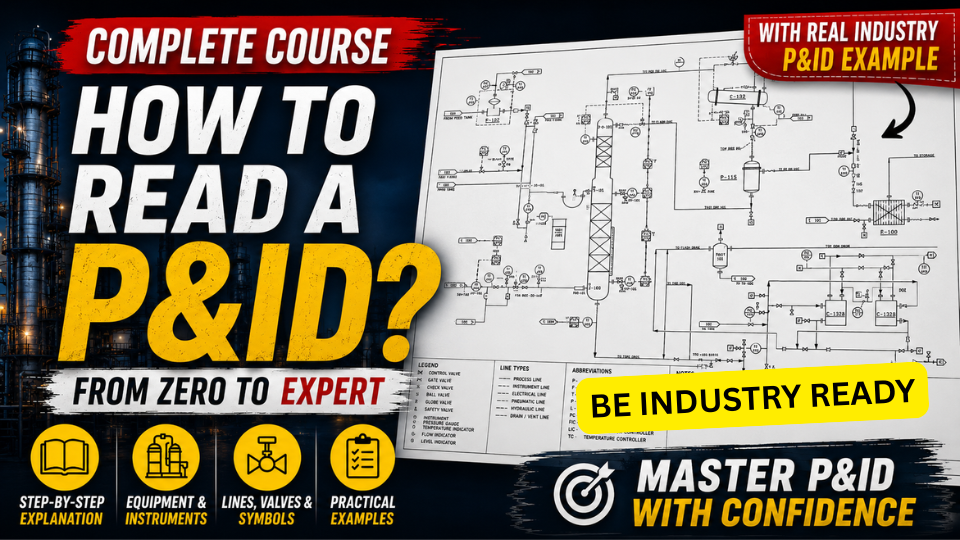
How to Read Piping & Instrumentation Diagram (P&ID) – About the Course
Piping and Instrumentation Diagrams (P&IDs) are among the most important engineering documents used throughout the lifecycle of every industrial plant. Whether you are working in Oil & Gas, LNG, Petrochemical, Refinery, Chemical, Pharmaceutical, Fertilizer, Water Treatment, Hydrogen, or Renewable Energy projects, the ability to confidently read and interpret P&IDs is an essential skill expected from every engineering professional.
The course should be suitable for
- Chemical Engineers
- Process Engineers
- Instrumentation Engineers
- Mechanical Engineers
- Electrical Engineers
- Freshers
- Experienced Engineers
- EPC Professionals
- Oil & Gas Engineers
- LNG Engineers
- Chemical Plant Engineers
This comprehensive course is designed to take you from the fundamentals to an advanced, industry-standard understanding of P&IDs used in real EPC projects. Instead of focusing only on theory, the course explains how engineers actually read, analyze, and use P&IDs during engineering design, procurement, construction, commissioning, operations, maintenance, troubleshooting, and plant modifications.
Throughout the course, you will learn every major element of a P&ID, including piping systems, valves, fittings, process equipment, instrumentation, control loops, safety systems, piping specifications, line numbering, utility systems, legends, notes, and engineering standards. You will understand the meaning behind each symbol and learn how all components work together within a complete process.
The course also demonstrates how to read real industrial P&IDs from various sectors, including Oil & Gas, LNG, Refineries, Chemical Plants, Pharmaceutical Industries, Fertilizer Plants, and Water Treatment Facilities. You will gain practical exposure to pumps, compressors, heat exchangers, pressure vessels, columns, reactors, storage tanks, control valves, transmitters, analyzers, emergency shutdown systems, safety relief systems, and much more.
Unlike basic introductory courses, this program follows the engineering workflow used by leading EPC organizations worldwide. You will learn professional techniques for tracing process flow, identifying equipment functions, understanding instrument control philosophy, verifying piping connections, interpreting line classes, and reading complex drawings with confidence.
The course also includes numerous real-world engineering examples, practical case studies, interview-oriented discussions, quizzes, and troubleshooting exercises to help reinforce your understanding. By the end of the program, you will be able to read complex P&IDs independently, communicate effectively with multidisciplinary engineering teams, participate confidently in engineering projects, and perform better in technical interviews.
Whether you are a student preparing for your first job, a graduate engineer entering the EPC industry, or an experienced professional looking to strengthen your technical skills, this course provides the knowledge and practical expertise needed to understand one of the most critical engineering documents used across process industries.
After completing this course, you will be able to:
- Read and interpret industrial P&IDs with confidence.
- Understand the purpose and function of every major P&ID symbol.
- Identify process equipment, piping systems, valves, instruments, and control loops.
- Interpret line numbers, piping specifications, and engineering notations.
- Understand process flow from raw material to final product.
- Read instrument identification tags based on ISA standards.
- Analyze process control and safety systems shown on P&IDs.
- Differentiate between PFDs, P&IDs, Isometrics, GA Drawings, and Plot Plans.
- Navigate complex engineering drawings used in EPC projects.
- Participate effectively in design reviews, HAZOP studies, commissioning, and plant operations.
- Improve technical interview performance for Process, Mechanical, Instrumentation, and EPC engineering roles.
- Apply P&ID knowledge confidently in Oil & Gas, LNG, Petrochemical, Refinery, Chemical, Fertilizer, Pharmaceutical, Water Treatment, Hydrogen, and Renewable Energy projects.
This course has been carefully structured to bridge the gap between academic learning and real industrial engineering practices, making it an essential resource for anyone who wants to build a successful career in the process industries.
If there is any doubt about the course or in any video lecture, reach out to us at WhatsApp +91 9599338839 or Email at infolearnche@gmail.com.
Wish You a Happy Learning!
Best of Luck.